Apple

Marcel

A couple of opinions about the iPhone Duo

I've been living with a foldable iPhone for more than a week now, and here's a quick list of things I've noticed so far:

  • I love it. Seriously. It's my favorite iPhone in years. It's exciting, interesting, versatile, and just a lot of fun.
  • It's harder to get out of my pocket. Years of muscle memory have trained me to expect my iPhone to be much taller, so now I have to reach a lot deeper into my pocket to get a grip on it.
  • Having the tab bar turn into a sidebar is fine. The only thing I don't like is the lack of labels for the icons. You can long-press the tabs to reveal them, but without them, navigating apps has become surprisingly more mentally demanding. Most icons apps use in their tab bars simply aren't that self-explanatory.
  • Taking screenshots and selfies is much more awkward because of where the buttons are positioned.
  • The inner screen is incredible. I love drawing on it, I love reading on it, and I love just looking at it. There's something about it that makes it feel like it shouldn't even be real.

I'll keep adding to this thread as more things come up. (Yes, this blog has threads now. Scroll up to see the previous entries!)

Marcel

iPhone Duo Preorder Madness

I already briefly mentioned it in this daily, but I wanted to expand a little on those times when we’d get up in the middle of the night, drive to the Apple Store, and wait for hours for it to open, all just to get our hands on the new iPhone on release day.

Even though we arrived four hours early (the store opened at 8 AM), we were never the first in line. In fact, we were sometimes late enough to worry that we might not get an iPhone at all.

I don't remember whether preorders weren't a thing back then or whether we somehow actively decided against them, but the thrill of standing in line in the middle of the night, surrounded by the buzzing excitement of people who, just like you, couldn't wait to get their hands on the next big breakthrough in technology, is a core memory of mine.

Marcel

I haven't been this excited about an iPhone launch since the days when I'd actually get up at 4 AM to line up outside the Apple Store and get my hands on an iPhone 5 or whatever …

iPhone launches have changed since then. Incremental updates have made them far less exciting. Back then, with the iPhone 3G, iPhone 4, and so on, there were incredible leaps from one generation to the next. Getting a new iPhone felt like getting a whole bunch of new possibilities.

Not least because the app ecosystem was so different back then. It felt like every week, some exciting new app would launch that had the potential to change society in one way or another. Twitter, Uber, and all those other services were emerging around that time.

One year, we even brought mulled wine in thermoses to make those four hours of freezing a little more bearable. In later years, some brands jumped on the bandwagon and started handing out hot drinks and even snacks to people waiting in line. Interesting times.

Things have changed since then. I don't think there have been any particularly meaningful changes, apart from overall performance improvements, between the iPhone 14 and the iPhone 18 Pro.

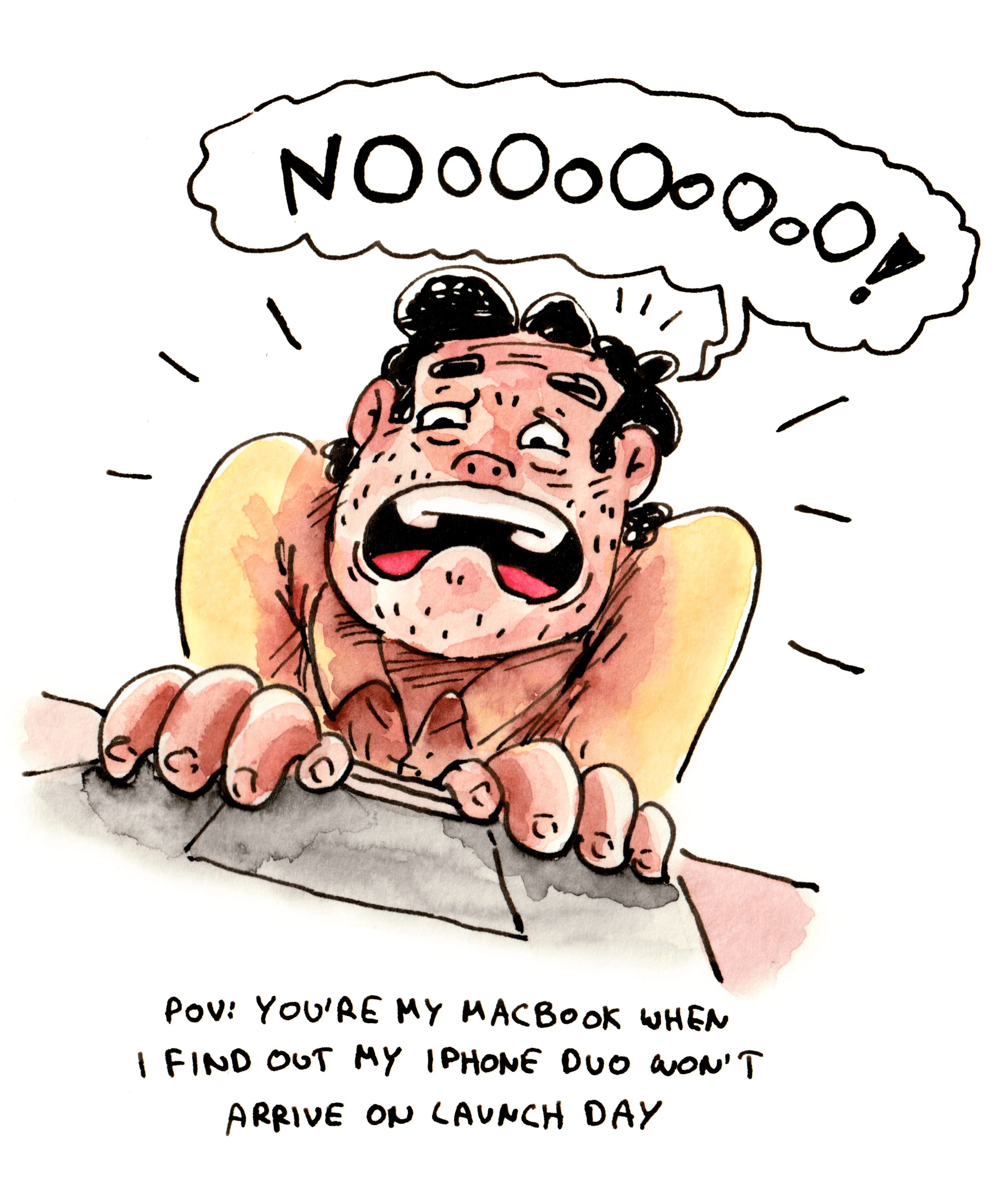
But now, with the iPhone Duo, that's changed. It's a whole new world (for iOS users, at least). It feels a little like the old magic is back. Which is exactly why I was so excited to get one on day one.

Seems like I can still consider myself lucky with a delivery window of November 10–17, though. The estimated delivery date for new orders has already slipped to February 2027.

That's not going to stop me from checking in-store pickup availability every morning starting October 23, though. I won't give up.

But I'm not going to stand outside in the cold for four hours before opening anymore, either. I've grown up a little in the past ten years, it seems.

Marcel

AirPods with Cameras Leaked

Here's a leaked video of Apple's AirPods with embedded cameras. Told you so!

Marcel

The more I think about it, the more AirPods with cameras in the stems make sense to me. Long-term readers of this blog know that I’m bullish on AR as the future of interfaces, and …

Marcel

The Case for AirPods with Cameras

The more I think about it, the more AirPods with cameras in the stems make sense to me. Long-term readers of this blog know that I’m bullish on AR as the future of interfaces, and until recently I considered glasses, or later on contact lenses, to be the primary interface to an augmented future.

But contact lenses are quite a way off, and we haven’t even managed to put high-quality screens in glasses that don’t make you look like a dork.

Now imagine wearing an Apple Watch, having an iPhone in your pocket, and using AirPods with cameras that somehow have a 360-degree view of everything around you. That could enable so many incredible use cases, all without you having to strap something new to your face.

Wearing AirPods is incredibly easy. I do it for hours each day. If they could see the road I’m walking on and tell me to “turn right just after that blue Toyota,” that would augment my reality quite a lot.

They could also do all the vaporware Google announced a year ago. The cameras could remember where I put my wallet, and I could ask Siri for its last location. A buzz on my wrist could show me a photo of the street corner and my wallet’s location on my Apple Watch or iPhone. There’s not much benefit in overlaying that information on top of what I’m actually looking at right now.

Other examples:

  • Warnings when someone is overtaking you on a bike: “On your left.”
  • Asking what that bookstore was called that you went into yesterday
  • Finding the shampoo from your shopping list on a crowded shelf

The cameras obviously wouldn’t work well for people with long hair unless it’s tied back, and I doubt the photos or videos would be worth much anyway. But tying your hair into a ponytail and not taking creepy shots is a lot easier than wearing a weird-looking pair of glasses on your face all day, especially if you don’t normally wear glasses. And keep in mind that plenty of people already wear AirPods for hours every day.

I’m a bit surprised by this, but this could actually be a cool product.

Update 2026/08/18: I forgot to mention a very important point: I don’t think these will include a feature for taking photos or videos through any kind of camera app. I believe they’ll only use the camera feed for visual intelligence, and that’s it. The image quality likely wouldn’t be good enough for decent photos anyway, and Apple certainly wouldn’t want headlines about people using AirPods to creep on women in public.

Marcel

Liquid Glass Review

I know that all of you are on the edge of your seats, waiting for my opinion on Liquid Glass. iOS 26 was released more than six months ago, and I had the strong feeling that it would take some time to really understand whether it's a good redesign or not.

It is. I like it.

All the criticism of it is valid, and I understand that if you think about it, Apple's arguments for the redesign don't make sense. But this isn't only about thinking. It's about vibes.

And the vibes are great. It feels good and modern, and contrary to my initial reaction, I don't think it'll age quickly anymore.

Marcel

iPhone 2X

Here is my prediction for the name of Apple’s foldable iPhone.

We are (roughly) in the 20th year of the iPhone. At year ten, Apple introduced the iPhone X, a real break from the past with a new design and a new way of interacting with the device.

Now it has been another ten years. (Not really, but they skipped the iPhone 9 to call it X, so they obviously don't care about precision.)

X is the Roman numeral for ten. XX is twenty. A foldable iPhone has two displays.

iPhone 2X

Twenty years (XX). Two screens (2x).

You heard it here first.

Marcel

Apple’s Vehicle Motion Cues Changed my Life

Apple nonchalantly released iOS 18 with a new feature that’s about to change the lives of a huge part of the population. Vehicle Motion Cues is an accessibility feature that’s on by default and activates when your iPhone detects a moving vehicle around you.

It works by layering a bunch of animated dots on top of the content you’re looking at. When the device detects changes in the vehicle’s motion, it animates the dots accordingly, tricking your brain into thinking everything is fine instead of making you feel like you need to puke because the real-life physics engine stopped working.

I’ve struggled with motion sickness and haven’t read a book in a car or bus in 29 years. I didn’t find it very convincing that showing little circles on top of everything else would help, but yesterday, I spent 24 minutes on a bus, reading a whole chapter, and I was completely fine.

That never happened before.

Vehicle Motion Cues works, and it literally changed my life.

Marcel

Comparing Spatial Apples with Oranges

Comparing the current Quest ecosystem to the very first iteration of Apple's Vision Pro doesn't make sense. This isn't because it wouldn't be a fair comparison, given that Vision Pro is still in its infancy, but rather because the Quest lacks an app ecosystem.

The word and definition of "app" do the heavy lifting in that sentence.

The Quest has a plethora of amazing experiences. It's the best platform for diving into literal virtual reality and shared (mostly gaming) experiences. While these are technically applications, they're not what people commonly think about as apps.

Spatial Computing

If you go ahead and browse through Meta's Quest Store, you'll find everything from drawing in the space around you, to virtual meeting spaces, to ways to learn piano and even a handful of solutions for those who want to work out while wearing their headset, for whatever reason. What you won't find are Slack, Discord, any kind of note-taking app, a way to write down tasks, or anything else you'd expect from your computer.

That's where Spatial Computing comes into play. The term is more than Apple slapping their branding magic onto something that was already available. Spatial Computing is computing. You, using a computer, in the space around you.

Let's consider the Xbox. Yes, tEcHniCalLy the Xbox is a computer but only pedants would call it that. It's a console and does a great job at being one. Sure, you can open a web browser on it but there's really no reason to do so on a regular basis. The Quest is more like a console than a computer.

A shared design language

As far as I know, there's not even a UI framework for Quest development. Most of it happens in Unity, which is notoriously bad when it comes to creating 2D interfaces. There are a handful of other solutions to get something running on Quest but there's no chance of Quest apps actually getting to a point where the system as a whole has a unified design language.

Which is fine for games/experiences, there's no unified design language between Fortnite and Assassin's Creed either. It doesn't matter, because they're unique experiences.

This is not fine for an operating system of a computing platform.

It might feel like a small and obvious thing that Apple allows iPad apps to run on Vision Pro but it isn't. On day one of Vision Pro, there were more apps to manage your calendar than after years and years of Quest's existence. Which makes sense, since one of them is a game console and the other is a computer. One of them more or less requires you to start your development in a game engine, the other allows you to create a good-looking, albeit basic todo app with 30 lines of code.

Can Meta massage Quest into becoming an app platform?

I guess?!

It would be a long way to get there and you'll arrive at the same "quality" of apps Android can try to boast about but it's possible in theory. Can Vision Pro be used for VR experiences? Sure. It's already possible, with the only caveat being that there are no available controllers at the moment.

Quest and Vision Pro only share one similarity: People strap displays to their heads to interact with software. Everything else is fundamentally different. It can be compared but there's not really a good reason to do so.

Marcel

My First Mac

It’s the Mac’s 40th birthday, and people on Mastodon are sharing their very first Macs.

Mine was a Mac Mini G4. I didn’t even realize that I actually had started using Macs before the Intel transition happened until I read the Wikipedia article about it just now. The hardware specifics didn’t interest me back then. Fifteen-year-old me wanted to become a designer and knew that all the designers he looked up to used Macs, so there was really no choice.

My previous computer was a very old and very slow PC that didn’t even run the games all my friends were playing together online. Let’s not even talk about the performance of my pirated copy of Photoshop CS2.

Me and my first Mac
This is me, using my very first Mac, thinking that I can totally get away with this hairstyle.

Unboxing and placing the Mac Mini on top of my weird glass corner desk felt like receiving a ticket into a whole new world. I finally could do the things I saw designers do online. OS X felt like it was a gift from the gods. Everything was pretty, worked well, and instilled in me an appreciation for excellence that I hadn’t felt before and that is still going strong.

Looking back, that Mac Mini G4 wasn’t just a piece of tech; it was the starting point of my design journey. It turned my aspirations into real projects and set the standard for what I expect from technology. As the Mac celebrates its 40th, I realize it’s not just about the machine but about the doors it opened for me. It’s funny how a small box can play such a big part in your story.

Marcel

An Involuntary Exercise in Patience

Disclaimer: This is going to sound extremely petty. Poor baby is frustrated because he logistically can’t spend €4000, oh no!

Attentive readers know that I’ve been talking about how VR and AR are going to be the future of interfaces for years. One of the main reasons for me finally getting into coding was knowing that I had to be able to manipulate real interfaces directly, especially when interface design is entering the third dimension.

Apple’s Vision Pro announcement came quite a few years after I first pronounced XR to be the future of computing. I immediately put the required money into a budget meant for Vision Pro as soon as it would become available. It was my goal to be there, on day one, playing around with the hardware, writing software, and experiencing the new frontier of interface design firsthand.

Well, that didn’t quite work out. I somehow didn’t expect Apple to only sell it in the US at first. That, combined with the fact that you need to go to an Apple Store to have your face and eyes measured for the device to be properly set up, creates a logistical hurdle that I’m not willing to jump over. I won’t fly to the US just to buy a device.

So, this is me, frustrated that I have to sit on the sidelines, watching other people discover a device I’ve been waiting for for years. This is obviously irrational because I’m not actually losing anything, except perhaps for a head start in spatial computing experience but still… it hurts a little.

At least it’s a good exercise in patience.